
Which Stream Should I Choose After 10th? Science, Commerce or Arts – Best Career Options & Guide 2026
This is the story of a student who, influenced by friends, chose a stream in Class 11—after completing which stream to choose after 10th—that they didn’t like at all. Because all their friends were opting for that same stream, and due to pressure from both friends and parents, the student went ahead with it; however, they barely managed to pass Class 11. Although they had the option to change their stream, they couldn’t bring themselves to do so. Consequently, when the Class 12 board exams arrived, they ended up with very poor marks. This isn’t the reality for just one student; countless students across India make mistakes when choosing their stream—a mistake that can end up ruining their entire future. That is why, in today’s article, I will explain how you should go about selecting your stream. I will walk you through the process in detail, step by step.
Hi everyone, I’m your ‘Aniket Bhaiya,’ and today’s article is all about stream selection—so read it carefully. To begin with, I’ve outlined some key questions—or rather, some warnings—that you must keep in mind when choosing your stream:
ocietal pressure
What will people say?” You might wonder, “If I choose Humanities, what will people think?” Well, you shouldn’t pay any attention to what others say!
Choosing a stream based solely on Class 10 marks:
: For instance, being told, “You scored 95% in Class 10, so you must take Science.” Don’t do that. You should choose your stream based on your own interests and your intended career path.
Confusion regarding career options
It’s common for students to feel uncertain—should I choose Commerce, or perhaps Arts? What is the scope? Will there even be any future prospects? There are so many possibilities—things you aren’t even aware of—which I will clarify for you today.
Never choose a stream just because your friends have chosen it.
I have seen many students ruin their futures this way. They think, “Since my friend has opted for this stream, I should too.” Do not make this mistake.
The fear of choosing the wrong stream
You might be plagued by an inner doubt: “What if I’m not cut out for Science? What if I’m not meant for Commerce? What if I’m not suited for Humanities?” Does this sound familiar? These are warning signs—significant red flags that you need to pay attention to.
Now, you might be wondering—how exactly should you go about selecting a stream? Let me walk you through the process. But first, do you know what the most important point is? I’ve brought along a few examples for you.
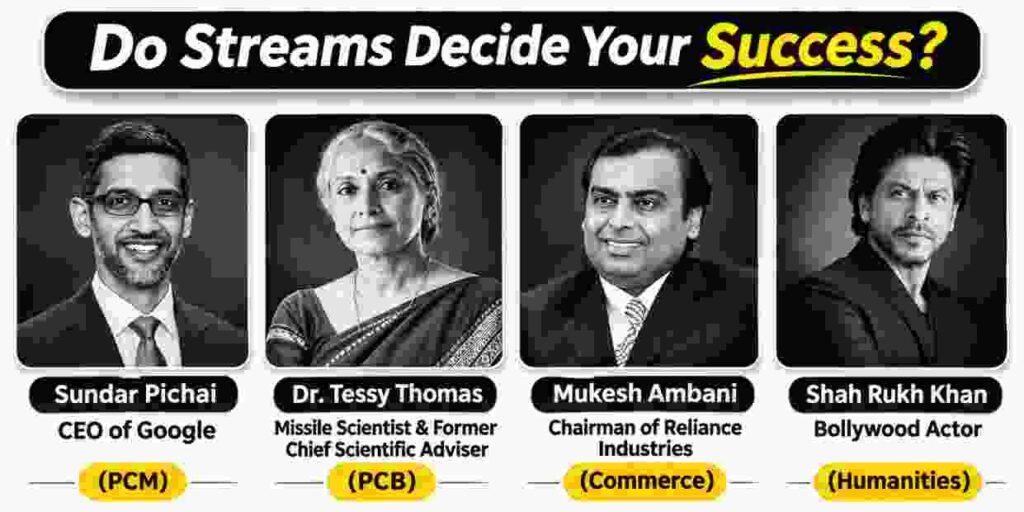
These are some individuals who, regardless of the academic stream they chose, have gone on to become successful. This goes to show that success has nothing to do with one’s chosen stream. Take Sundar Pichai, for instance—everyone knows him, right? He studied PCM (Physics, Chemistry, and Mathematics). There are countless such examples. Even I studied PCM, and today, I am a teacher. Consider another example: Shah Rukh Khan—he studied Humanities, and today, he is an actor. So, there is no correlation between one’s stream and one’s success. That’s the first point. Nevertheless, choosing a stream is still an important decision. How should you go about it? You have two options.
TYPES OF STUDENS
| According to Interest | According to Career goal |
The first approach is based on your interests. You might be wondering, “How do I figure out where my interests lie?” I’ll explain that shortly. Another approach is based on your goals. Many people already have a specific goal—for instance, they might know for certain that they want to become an engineer or a doctor. If you already have a goal, choose your stream accordingly. If you don’t have a specific goal yet, then choose your stream based on your interests. Let’s explore this in detail, one by one. We’ll start with the approach based on your goals.Suppose you have a specific goal—which stream should you choose? As you likely know, the available streams are Science, Commerce, and Humanities
If you choose PCM in the science stream
what will your core subjects be? Physics, Chemistry, and Mathematics
| Physics | Chemistry |
| Mathematics | English (compulsory |
| Computer Science | Physical education |
| Economic, Biology , IT | Language paper |
If you choose the PCB in the science stream
then Physics, Chemistry, and Biology become your core subjects. There is another stream as well.
| Physics | Chemistry |
| Biology | English (compulsory |
| Mathematics | Physical education |
| Biotechnology, psychology | Language paper |
If you choose the PCMB that is, both Mathematics and Biology.
PCMB—that is, both Mathematics and Biology. However, if you are considering choosing this, I would suggest you think it over once more, as it is going to be extremely challenging. In fact, statistics show that 90% of students who opt for PCMB end up giving up after the 11th grade. Given this data, I strongly advise you to reconsider before committing to this stream—please think it through carefully. Alright?
| Physics | Chemistry |
| Mathematics | Biology |
If you choose in the Commerce stream,
When it comes to the Commerce stream, everyone is familiar with the core subjects: Accountancy, Business Studies, and Economics. Additionally, you can choose Mathematics as an optional subject. Many Commerce students opt for Mathematics, which is a great choice. I personally recommend taking Commerce with Mathematics, as it opens up a wide range of career opportunities for you. Alright?
| Accountancy | Business Studies |
| Economics | English (compulsory |
| Mathematics / Applied Mathematics | Entrepreneurship |
| Information technology | Physical education |
If you choose in the humanities stream
When it comes to the humanities, a wide range of combinations is possible. Core subjects include history, political science, geography, economics, and English; beyond these, there are many other subjects that you can also choose to include.
| History | Political science | Geography |
| Economics | Sociology | psychology |
| Hindi | English | Music |
| Media studies | Foreign Language | Fine Arts |
| Philosophy | Legal studies | Physical education |
What are the career opportunities for PCM, PCB, Commerce, and Humanities?
There are career opportunities with PCM.
| Stream | Degree Options | Career Opportunities |
| Science (PCM) | B.Tech/B.E (Engineering) B.Arch (Architecture) B.Sc. (Physics, Chemistry, Maths) BCA (Computer Science) NDA (Defence) – B.Sc. Aviation | Engineer Management Architect Data Scientist Pilot/Merchant Navy Defence Officer (Army, Air Force, Navy) Teaching |
If you choose PCM, you can pursue a wide range of degrees—such as B.Tech, B.Arch, B.Sc., BCA, or even join the NDA. Regarding career opportunities: if you are certain that you want to become an engineer, then you should definitely opt for PCM. Similarly, if you know for sure that you want to be an architect, then PCM is the right choice for you. These are some of the career paths you can pursue through this stream. You might ask, “Can I still prepare for the UPSC if I take PCM?” The answer is yes, absolutely—but the path might become a bit more challenging, as the UPSC and the PCM stream are quite different from each other. These are the various career opportunities available.
There are career opportunities with PCB.
| Stream | Degree Options | Career Opportunities |
| Science (PCB) | •MBBS (Doctor) •BDS (Dentistry) •BAMS (Ayurveda) •BHMS (Homeopathy) •B.Sc. NursingB.Pharm (Pharmacy) •B.Sc. Biotechnology •BMLT (Medical Lab Tech) | •Doctor (Surgeon, Physician, Dentist) •Pharmacist •Biotechnologist •Medical Researcher •Physiotherapist •Nutritionist/Dietitian •Scientist- ISRO |
If we talk about the PCB stream—that is, Physics, Chemistry, and Biology—the most prominent career opportunity is, of course, becoming a doctor. Everyone knows that, right? But beyond an MBBS, there are many other degrees that people rarely even discuss. Many assume that if you choose PCB, you must become a doctor—but that’s not necessarily the case. There are so many other options available! You could pursue fields like B.Sc. Nursing or B.Pharma, among many others. Being a doctor isn’t the only path; there are numerous career opportunities. For instance, consider the field of biotechnology—it’s currently experiencing a major boom, especially outside of India, and it’s likely to see significant growth within India as well in the coming years. You could even become a scientist. In short, this stream offers a wide range of career possibilities.
There are career opportunities with Commerce
| Stream | Degree Options | Career Opportunities |
| Commerce | •B.Com (Bachelor of Commerce) •BBA (Business Administration) •CA (Chartered Accountant) •CS (Company Secretary) •CFA (Financial Analyst) •BMS (Management Studies) •Hotel Management | •Chartered Accountant (CA) •Investment Banker •Business Analyst •Stock Market Expert •Entrepreneur •Hotel Manager •Economist •Journalism •Digital Marketer •Stock Market |
If you choose the commerce stream, a wide range of degree options becomes available to you—such as B.Com, BBA, CA, CS, or even programs in hotel management. As for career prospects, while becoming a CA is a common goal for many commerce students, there are numerous other opportunities as well. You could pursue roles like hotel manager, business analyst, or investment banker—these are just a few of the many paths you can explore by choosing the commerce stream.
There are career opportunities with Humanities
| Stream | Degree Options | Career Opportunities |
| Humanities (Arts) | •BA (Bachelor of Arts) •BA LLB (Law) •BJMC (Journalism & Mass Comm.) •BFA (Fine Arts) •B.Ed (Teaching) •BSW (Social Work) •BA Psychology / Sociology / Political Science | •Civil Services (IAS, IPS, UPSC) •Lawyer •Journalist / News Anchor •Psychologist / Counselor •Teacher / Professor •Writer/ Editor •Fashion Designer •Social Worker •Government Services |
If we talk about the humanities, you will have a wide range of degree options available. You can explore all these various degrees. As for career opportunities, the civil services—such as the IAS, IPS, and other UPSC-related roles—are a primary option. You could also become a lawyer, or pursue a career in journalism, which offers significant scope. Beyond that, paths like teaching, writing, and fashion design are also open to you; there are many such opportunities available in this field.
There are other career opportunities
| Stream | Degree Options | Career Opportunities |
| Other career paths | •Polytechnic Diplomas •Animation & VFX •Gaming & Esports •Photography •Event Management •Foreign Language | •Graphic Designer •Game Developer •Travel & Tourism Expert •Event Planner •YouTuber/Influencer •Foreign Embassy Translator |
Furthermore, there are certain jobs where the stream you choose doesn’t matter at all; you can pursue these career opportunities regardless of your academic background. Take a graphic designer, for instance—you can become one no matter which stream you studied. In fact, there are many such opportunities open to students from any stream. In other words, every stream offers a wide range of career paths. Now, first consider whether any of these align with your own goals or dreams. If you aspire to pursue one of these, then choose the corresponding stream. Think in terms of your dreams!
Furthermore, there are certain jobs where the stream you choose doesn’t matter at all; you can pursue these career opportunities regardless of your academic background. Take a graphic designer, for instance—you can become one no matter which stream you studied. In fact, there are many such opportunities open to students from any stream. In other words, every stream offers a wide range of career paths. Now, first consider whether any of these align with your own goals or dreams. If you aspire to pursue one of these, then choose the corresponding stream. Think in terms of your dreams!
If you are still feeling confused—if you’re thinking, “Well, one of these might be my dream, but I’m just not sure”—then what should you do? You should make your choice based on your interests. But how do you go about that? You’ll need to ask yourself a few questions. For instance, if a student comes to me and says, “I have a strong interest in mathematics,” I would ask them three or four specific questions.
1. First question: Can I study these subjects seriously for two years? For instance, can you study Mathematics seriously for the next two years—dedicating an hour to it every single day? Do you have the inner strength to commit to this? If the answer is ‘yes,’ then that subject is likely your favorite.
2. Sceound question: Do I understand the basic concepts? Do you grasp the fundamentals of the subject? In classes 9 and 10, did you truly understand the material, or were you simply memorizing it just to score marks? If you actually understood the concepts, then yes, it is your favorite subject.
3. And the third question: Marks alone do not tell the whole story. Just because you scored, say, 98 in Mathematics in class 9 or 10, it doesn’t necessarily mean it’s your favorite subject. Ask yourself: did you actually enjoy solving Math problems? Did you find pleasure in working on Science—Physics or Chemistry? Or perhaps you enjoyed studying or working on Social Studies (SST)? Where does your true interest lie? These three questions should help clarify where your genuine interests truly are.
If things are still not clear, I have a simple chart for you. What is this chart? It starts with a question you need to ask yourself:
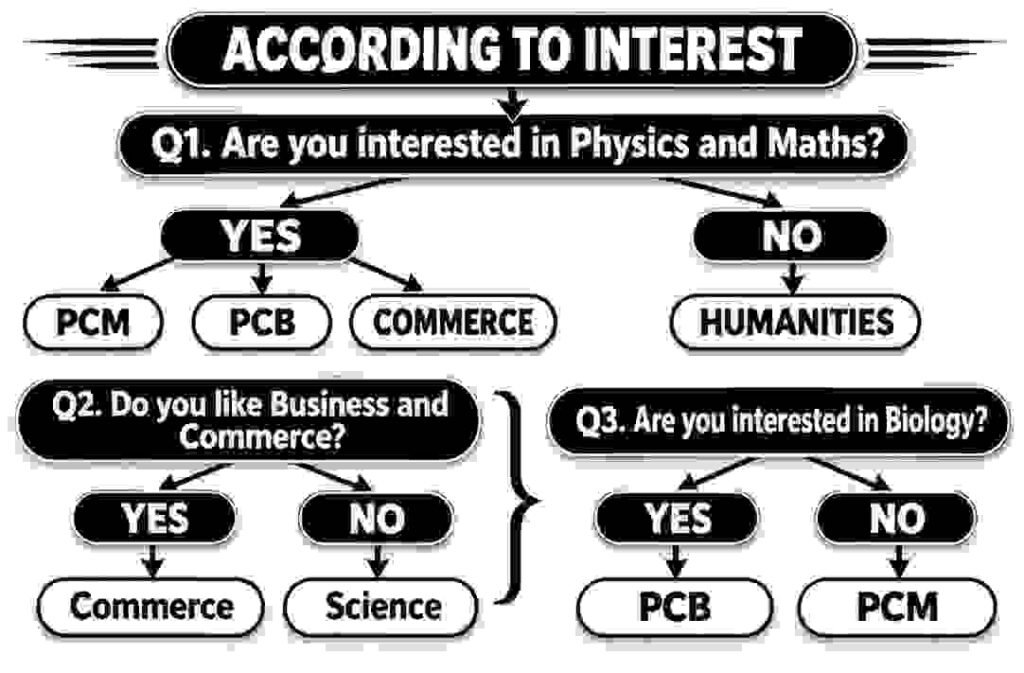
Are you interested in Physics and Mathematics? You studied both Physics and Mathematics in Class 10th—did you enjoy solving numerical problems? Did you find it fun to tackle difficult, logic-based questions?If your honest answer is “no”—if the very thought stresses you out—then the answer is simple: choose Humanities. In that stream, you won’t encounter even a trace of Mathematics or Physics. So, go for Humanities. But if your inner self says “yes”—if you truly had an interest in Mathematics—then you have three career paths: PCM, PCB, or Commerce. Ask yourself: were you deeply interested in Mathematics? Did you truly love the subject? If the answer is a resounding “yes,” then choose PCM and you’re all set. That leaves us with two options: PCB and Commerce.
Now, ask yourself: do you have an interest in the business world? Do you envision yourself building a business in the future?If the answer is “yes,” then choose Commerce. Whether you take it with or without Mathematics is entirely up to you; but if you have an interest in business—if you feel that you might want to pursue something related to business in the future—then choose Commerce. It will be highly beneficial.That leaves us with PCB. You might say, “But wait, doesn’t PCB exclude Mathematics?” Well, it actually includes both Mathematics and Physics. Physics in classes 11th and 12th is absolutely packed with mathematics—truly, it’s everywhere. You’ll realize this once you start studying it; you’ll encounter differentiation and integration throughout the entire physics curriculum. That is why I say you cannot opt for PCB (Physics, Chemistry, Biology) without having to deal with math. You might think, “Oh, I won’t have to study math anymore,” but that’s not the case—you will still encounter it within your physics studies. Granted, it won’t be as intensive as it is in the PCM (Physics, Chemistry, Mathematics) stream, so if you are reasonably comfortable with math, you can certainly choose PCB.
I have already explained the career opportunities for each stream in great detail. Now, the decision is yours: will you choose PCM, PCB, Commerce, Commerce with Math, or Humanities? I’ve covered everything thoroughly, but as an elder brother, I’d like to offer a few final tips. First and foremost: don’t compare yourself to others. You might think, “Someone I know became a CA, so I should choose Commerce too”—please, don’t make comparisons! Their capabilities might be different from yours. They became a CA, but perhaps you are destined to build a massive business, or maybe your goal is to get into an IIT. Your aspirations could be entirely different. Next, talk to your parents. I know they might push you to become a doctor or an engineer, but have an open conversation with them. Share your dreams, your goals, and where your true interests lie. Show them this article and explain things to them. Remember, the stream you choose will not determine how successful you become in life; the stream itself doesn’t make the difference. What you ultimately achieve in life will depend on your determination and your dedication—keep that in mind. Think carefully before choosing PCMB. I’ll say it again: if you are considering PCMB, take some time to reflect, understand yourself, and explore your career options—all without any external pressure. You need to understand yourself; don’t let outside influences pressure you—there’s no need for that. This is an important decision, and it must be your own—it should be a choice you make for yourself. As for the level of difficulty, the Science stream is the most challenging—whether it’s PCM or PCB. Commerce is also difficult, while Humanities is somewhat less demanding—though it’s not as if Humanities is ‘easy’ by any means. Still, when compared to Science, Humanities is indeed less difficult.